Skip to content

Cart

Your cart is empty

Article: Same problem, on the other wheel

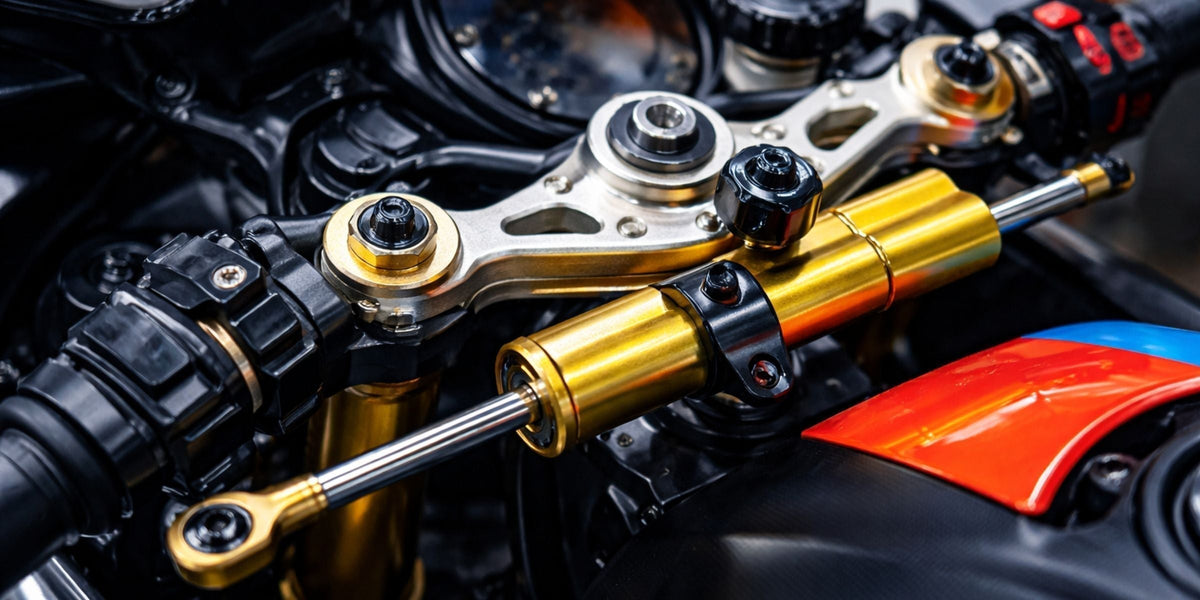
Amortiguador de dirección ajustable en acabado dorado instalado en motocicleta de competición con kit de suspensión premium

Same problem, on the other wheel

There's a device that no sport motorcyclist questions. It comes standard on almost all high-displacement motorcycles, it's mandatory in competition, and no one considers it an exotic accessory.

The steering damper.

Its history is instructive. It exists because the front end has a problem that the forks cannot solve: high-frequency handlebar oscillations — headshake, the dreaded wobble — occur too quickly for conventional suspension to manage them. The solution was not to improve the forks. It was to add a specific device, calibrated for that frequency range, that works in parallel with the suspension without replacing it.

Does that approach sound familiar?

The same problem, on the other wheel

The rear wheel has its own high-frequency oscillation that the suspension cannot manage: the elastic rebound of the tire. The same nature of the problem — a phenomenon faster than the working range of the main system — the same structural impossibility of solving it with a conventional shock absorber, no matter how good it is.

The difference is historical, not technical. Front headshake is violent, visible, and terrifying: it shakes the handlebars in the rider's hands. Rear rebound is silent: micro-lifts that aren't felt one by one. The front got its specific device decades ago because it was scary. The rear went without it because its damage is cumulative and invisible.

Until now.

Two devices, one same logic

The parallelism is direct, with a mechanistic difference worth clarifying. The steering damper is dissipative: it slows down handlebar oscillation by converting its energy into heat through a hydraulic circuit. The Gravitational Resonator goes a step further: it doesn't dissipate rebound; it counteracts it with an active, out-of-phase force that pushes the tire back to the ground.

But the underlying logic is the same that motorcyclists already accepted years ago for their front end: when a phenomenon occurs outside the suspension's range, the answer is not a better suspension. It's a specific device for that range.

No one asks a steering damper why its forks don't do that job. The correct question for the rear wheel is the same: it's not "why do I need another device?", but "why has my rear wheel been without its own for decades?".

The front end solved its high-frequency oscillation a long time ago. Now it's the rear's turn.

 → FIND YOUR KIT

Find your bike

Blog posts

Resonador Gravitacional Oversuspension — ¿dónde está el sensor? No hay chip ni electrónica

Where does the sensor go on the Oversuspension?

Almost everyone's first reaction when learning about the Gravitational Resonator is to look for the chip. Where does the sensor go? What ECU controls it? How often does it sample? There is no chip....

Read more
Motorista tomando una curva en carretera de montaña mojada — control y respeto en moto

The difference between fear and respect on a motorcycle

There are two motorcyclists taking the same wet curve. They are going at the same speed, on the same bike, in the same rain. One is stiff. His arms are rigid on the handlebars, his gaze fixed three...

Read more
oto de enduro en terreno off-road con suspensión en acción sobre piedras y tierra suelta

Off-road: where the bounce isn't hidden

On asphalt, tire bounce is an invisible phenomenon. Milliseconds, micro-lifts, physics that occur below the rider's perception but have consequences. Off-road, bounce is constantly visible and noti...

Read more
riángulo dorado con amortiguador, neumático y kit Oversuspension — los tres elementos de la trinidad perfecta del motociclismo

The Trinity

The perfect trinity of motorcycling There are riders who buy the best bike on the market and assume they have everything they need. And there are riders who understand that the bike is a system, an...

Read more
Neumático frío, rebote máximo

Cold tire, maximum rebound

The first 15 minutes: cold tire, maximum rebound. Every rider knows it intuitively: the first few kilometers of every ride are different. The bike feels stiffer, grip is less confident, and confide...

Read more
Curva mojada

Wet curve

The Wet Corner: The moment ABS can't save you There's a scenario no street rider forgets: the mountain curve, the wet asphalt, the correct speed. You weren't going fast. You didn't make any obvious...

Read more
La regulación del Resonador cambia con ellos. La misión de la rueda no: permanecer pegada al suelo

Passenger and luggage

Passenger and luggage: a loaded motorcycle bounces differently Your suspension was calibrated for a specific scenario: your weight, your motorcycle, your usual conditions. Every spring, every prelo...

Read more
Comparativa entre la suspensión convencional de moto y el Resonador Gravitacional Oversuspension trabajando en distintos rangos de frecuencia Hz

Two systems, one goal

Frequencies: Suspension works slowly, the problem occurs quickly Every motorcycle suspension has a natural oscillation frequency, determined by the mass of the assembly and the spring's stiffness. ...

Read more
Se parece más a un arma que a una suspensión

It looks more like a weapon than a suspension

Is the Gravitational Resonator more like a weapon than a suspension? The short answer is yes. And there's no hiding it. It needs to be explained. The mechanism they share A gun works on a simple pr...

Read more

free returns

lifetime warranty

try it risk-free

payment in installments