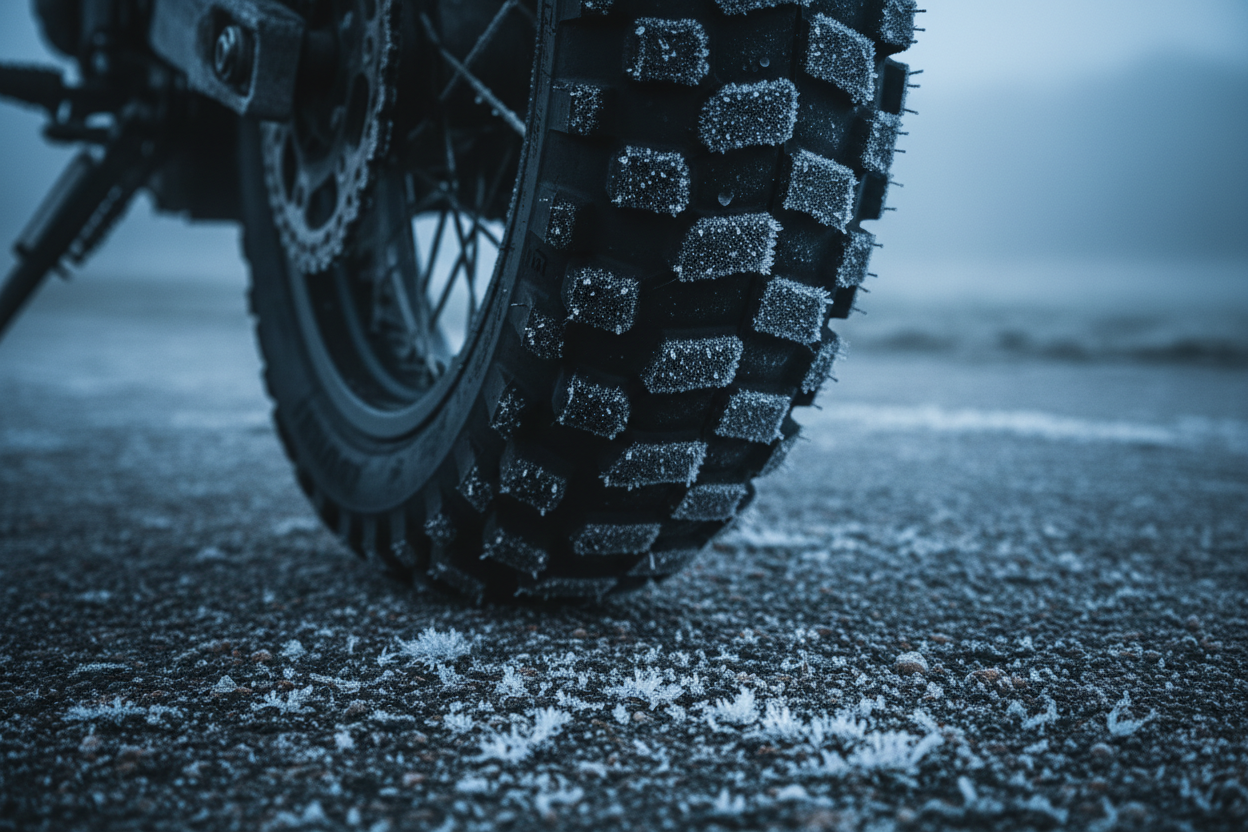

Article: The price of the rebound: what it costs you in money, in safety, and in your own body

The price of the rebound: what it costs you in money, in safety, and in your own body
Rear tire bounce is invisible. It doesn't show up on the dashboard, you don't consciously feel it, and no warning light illuminates. And that's precisely why it's so costly: you're constantly paying for it without realizing it. Three bills.
Every time the rear wheel hits an irregularity and bounces, it loses contact with the ground for milliseconds. That instant, repeated thousands of times per kilometer, comes at a price. In reality, three prices paid in three different currencies: money, safety, and your own body.
The Economic Cost: What Bounce Takes From Your Wallet
Tires that wear out sooner than they should. A bouncing tire doesn't wear its tread uniformly. The micro-lifts and re-establishments of contact generate irregular wear—the well-known cupping, those undulations you feel when you run your hand over the rubber. The result is a tire that needs replacing sooner, with degraded feel long before its theoretical lifespan is over. Each bounce is a bit of rubber prematurely worn away.
The drivetrain that suffers in silence. The energy from the bounce doesn't disappear: it travels up the kinematic chain. In shaft-driven transmissions, it reaches the micro-gears as repeated micro-impacts that cause pitting—the surface damage that degrades gears until failure. In chain drives, these jerks accelerate the wear of the chain, sprocket, and rear wheel. These are expensive components, and bounce extracts a toll that you don't see until the mechanic gives you the estimate. We elaborate on this in detail here.
Suspension that works overtime. Every anomalous disturbance the tire sends upwards is extra work for the shock absorber and fork, outside their calibration range. More cycles, more heat, more component fatigue. A suspension that constantly handles what it shouldn't ages prematurely.
Add up premature tires, a punished drivetrain, and overstressed suspension. The economic cost of bounce is real, recurring, and comes in installments you never associate with its true cause.
The Safety Price: What Bounce Takes From Your Margin
Here, the currency is no longer money. It's your control over the motorcycle.
Intermittent traction. A bouncing tire transmits power in jerks. With each micro-lift, the wheel doesn't grip: it slips for an instant, traction control cuts power, and acceleration becomes irregular. Just when you need the cleanest power delivery—exiting a corner, overtaking—bounce interrupts it.
Compromised braking. Brakes only brake what touches the ground. When the wheel is in the air, there's no surface to act upon, and ABS—however advanced—cannot manage grip that doesn't exist. Bounce increases braking distances in a way that doesn't appear on any spec sheet. This becomes critical on wet curves.
Degrading stability. The gyroscopic effect that keeps your motorcycle upright requires the wheel to be anchored to the ground. Each lift-off is an instant when that "free" stability weakens. In a curve, on broken asphalt, in wet conditions, that instant is the difference between the motorcycle following your line or veering off. And with a cold tire in the first few kilometers, the effect is exacerbated.
And at the extreme, a crash. The highside—the most violent type of crash—almost always originates from the same place: a tire that lost contact and suddenly regained it at the wrong moment. Bounce is the prerequisite. Without lift-off, that crash has no origin.
The price of safety isn't paid in small installments like the economic cost. It's paid all at once, on a single day, in the wrong situation.
The Physical Cost: What Bounce Takes From Your Body
You finish a long ride and you're exhausted. Numb hands, aching forearms, tense back, that feeling of fatigue that goes beyond the hours you've spent. You blame it on the wind, concentration, posture. And there's some truth to that. But part of that fatigue has a very specific mechanical origin that is almost never mentioned: the vibrations that tire bounce transmits to your body.
The energy from the bounce that doesn't cause damage or wear travels further: it goes through the swingarm, runs along the frame, goes up through the handlebars and footpegs, and ends exactly where you are in contact with the motorcycle—your hands, feet, seat. Your body becomes, without your choosing, the last shock absorber in the chain: what the suspension doesn't manage and the structure doesn't absorb, you absorb.
And this is not a brand metaphor. The exposure of the human body to mechanical vibrations has been a studied medical and occupational safety field for decades. The vibration that reaches through the handlebars is transmitted to the hands and travels up the forearms; sustained exposure to hand-arm vibration is recognized as a cause of numbness, tingling, loss of sensation and grip strength—the set is known in the workplace as Hand-Arm Vibration Syndrome. At the same time, to dampen that vibration, your muscles constantly and unconsciously tense up: hands, forearms, shoulders, neck, lower back. You end up tired even if you haven't made a visible effort, because you've been doing continuous micro-effort for hours.
And fatigue has its own safety price: a tired rider reacts worse, numb hands lose precision in the controls just when you might need them to be delicate, and concentration degrades with physical exhaustion. Vibration doesn't just wear you down: it makes you a slower and less precise rider as the miles pass.
Three Bills, One Origin
What makes bounce such a particular problem is that it charges threefold. It slowly empties your wallet—tires, drivetrain, suspension—it reduces your safety margin without you noticing until the day you need it, and it wears down your body ride after ride, leaving you exhausted without you fully knowing why.
And all three bills have the same origin: the rear wheel not staying magnetically attached to the ground. It is also the cause of the irregular wear that explains hysteresis.
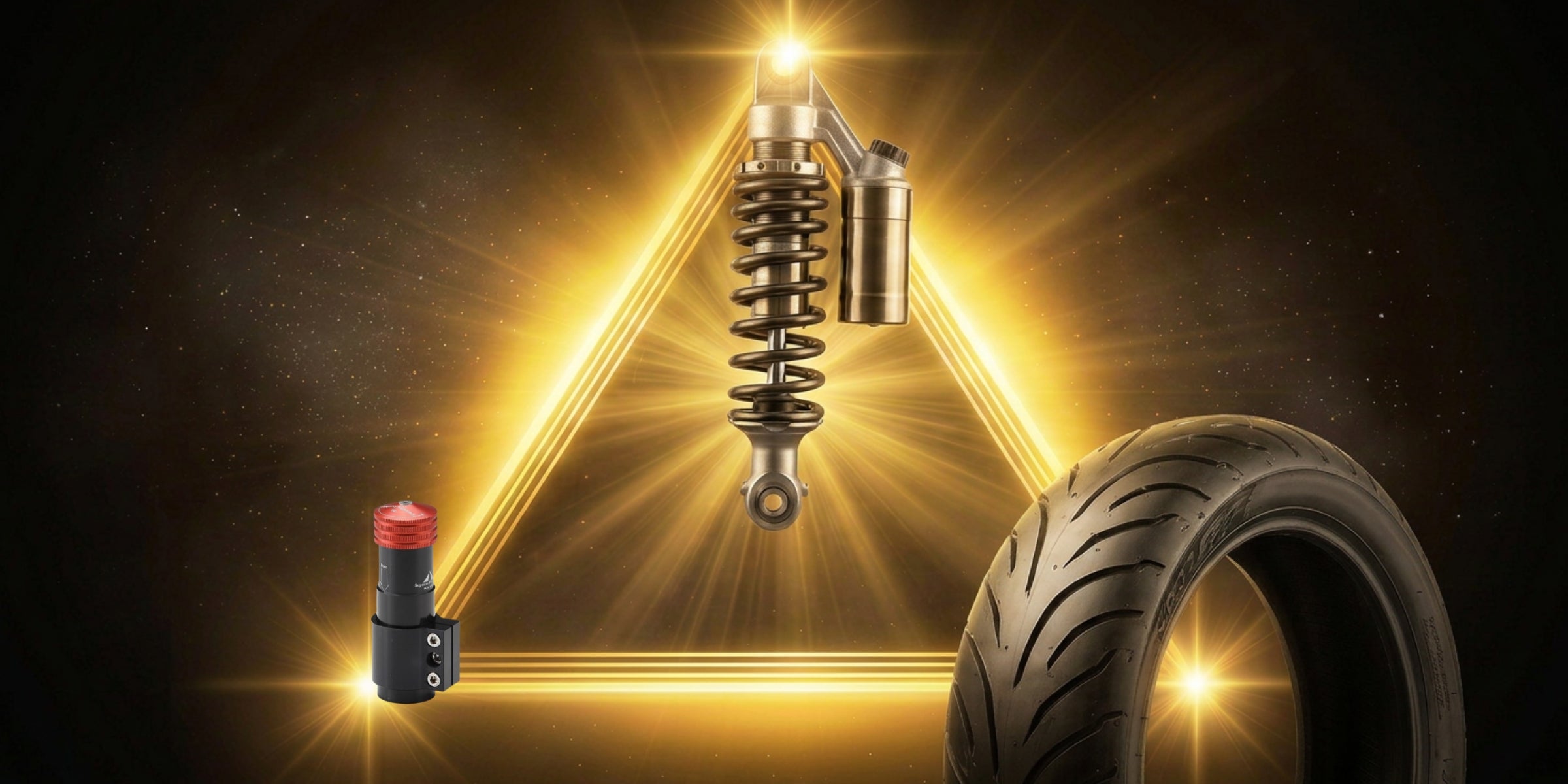
Oversuspension's Gravitational Resonator acts precisely on that common cause. By counteracting bounce at the instant it is generated, it keeps the tire in constant contact with the ground and cuts off a significant part of the energy—the energy that punishes the mechanics, compromises control, and travels as vibration to your hands—before it begins to spread. Less wear, more safety margin, and less vibration ending up in your body: you arrive at the end of the ride less exhausted, more precise, and safer.
It's not just another expense for your motorcycle. It's what stops you from paying the three bills you've been paying unknowingly. Because the last component that absorbs tire bounce, when no one else manages it, is you.