
The Trinity
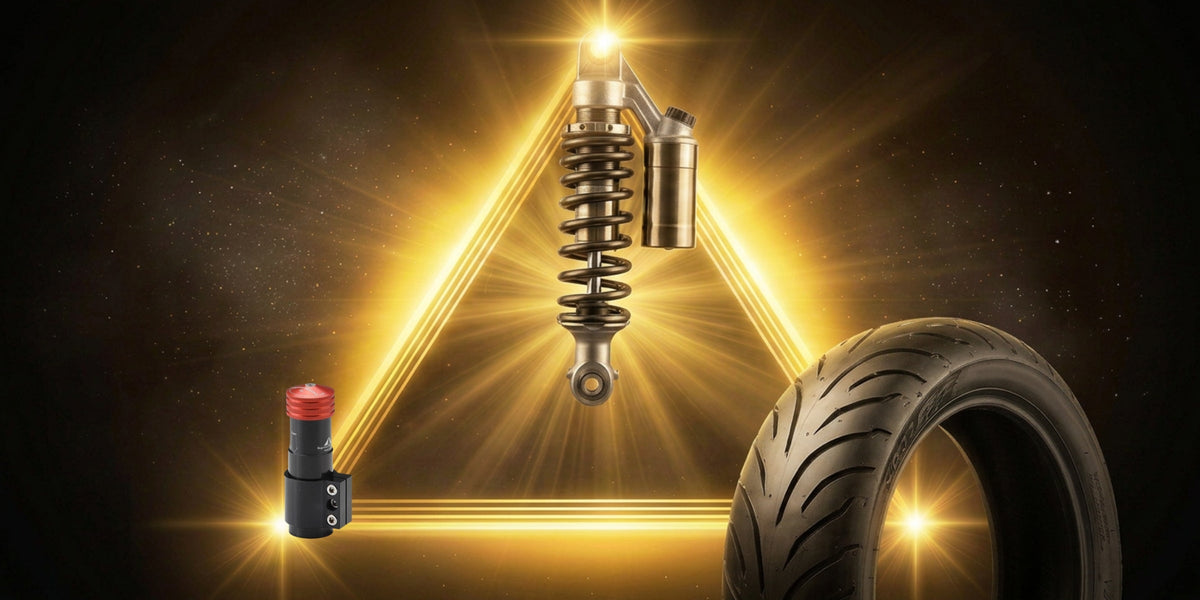
The perfect trinity of motorcycling
There are riders who buy the best bike on the market and assume they have everything they need. And there are riders who understand that the bike is a system, and that a system only performs at its best when each of its elements is at its optimal point.
The difference between the two is noticeable in every turn.
The first element: well-tuned suspension
A high-quality suspension that is poorly tuned is almost worse than a mediocre suspension that is well-adjusted. The components may be the best on the market — large-diameter fork, high-end shock absorber, racing geometry — but if the tuning is not adapted to the rider's weight, riding style, and terrain type, the system operates outside its optimal range.
A well-tuned suspension is one that manages mass transfer during braking without the front end diving, that absorbs impact without transmitting it to the chassis, that keeps the bike's geometry stable during cornering. It is the structural foundation upon which everything else rests.
Without it, nothing works as it should.
The second element: the correct tire at the correct pressure
The tire is the only point of contact between the bike and the real world. We already know: 92 cm² of rubber that decides everything. But a high-end tire mounted with incorrect pressure is a tire that cannot deliver what it promises.
Excessive pressure reduces the contact patch, stiffens the tread, and causes the tire to bounce more violently with every road irregularity. Insufficient pressure deforms the tire unevenly, generates excessive heat, and compromises response in sudden transitions.
The correct pressure is what allows the tire to work within its designed geometry: one that maximizes the contact patch, distributes the load evenly, and allows the compound to reach its optimal operating temperature.
A good tire at the correct pressure is one that delivers on its promise. One that grips where it needs to grip, informs where it needs to inform, and lasts as long as it should.
The third element: Oversuspension
Tuned suspension. Correct tire at correct pressure. The system is ready. But there is one variable that neither of the previous two elements can control: uncontrolled tire rebound in the time interval in which it occurs.
The suspension is late. The tire cannot manage itself. And in those milliseconds when the wheel loses contact with the asphalt, all the investment in quality suspension and premium tires is useless.
Oversuspension acts exactly in that interval. It counteracts rebound in real-time, keeps the tire glued to the asphalt, and allows the suspension to work within its optimal adjustment range. It does not replace either of the previous two elements. It complements them. It makes them perform at the level for which they were designed.
All three together: the maximum a rider can aspire to
A well-tuned suspension defines the dynamic foundation of the bike. The correct tire at the proper pressure maximizes contact and grip. Oversuspension eliminates the only factor that neither of them can control alone.
Three elements. Three layers of optimization. Each solving what the others cannot.
When all three work together, the bike does what you ask it to do. Always. In every turn. In every braking maneuver. On every meter of asphalt.
That is the maximum a rider can aspire to. And for the first time, it is within anyone's reach.