
Passive safety, active safety, and Oversuspension: where each one fits
When we talk about motorcycle safety, almost everything falls into two categories. But there is a third level that almost no one talks about, and that is exactly where Oversuspension works. Let’s break it down.
Passive safety: what protects you when the accident is already happening
Passive safety does not prevent a fall. It reduces damage once it is inevitable. It is everything you wear:
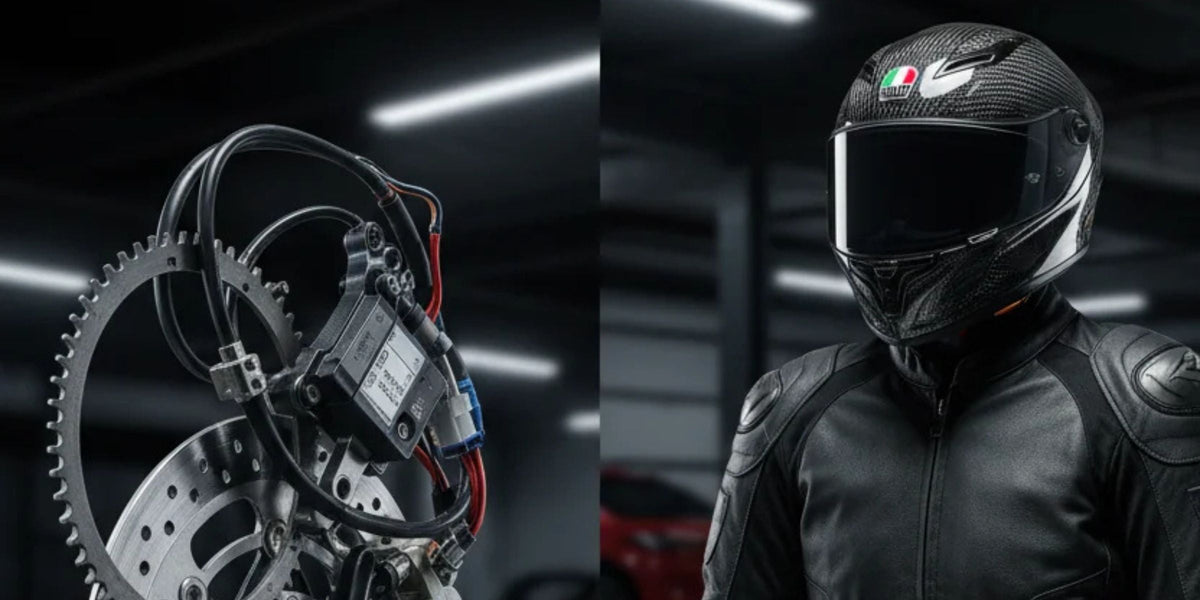
The helmet, the barrier between your head and the impact. The jacket, pants, gloves, and boots with homologated protectors, which absorb energy and resist abrasion. And the airbag —today a vest or integrated into the jacket—, which triggers in milliseconds before your body hits.
Passive is essential, but it arrives late by definition: it acts when you are already falling. Its work begins where control has already been lost. On the road, moreover, there are no runoff areas.
Active safety: what helps prevent the accident
Active safety acts before the impact, trying to ensure it never happens. It is the electronics that correct a loss of control that has already begun:
ABS, which prevents wheel lockup during braking. Traction control, which manages slippage during acceleration. Stability control and riding modes, which adjust the bike's response to conditions.
It is excellent technology. But it has a structural limit that almost no one mentions: all active safety needs the tire to be touching the ground to function.
ABS modulates braking pressure on a wheel that has grip. Traction control manages torque on a wheel that has contact. They all read what happens at the tire-ground contact point and act upon it. If the tire is in the air, there is nothing to act upon. The most advanced system on the market cannot manage grip that does not exist. In wet corners, this becomes critical.
The level no one talks about: before active safety has to act
This is where Oversuspension appears, and it does not fit perfectly into either of the two previous categories. It works a step below active safety.
Active safety reacts to a loss of control that has already begun. Oversuspension acts beforehand: it avoids the condition that causes that loss. By counteracting tire bounce the instant it is generated, it keeps the wheel glued to the ground —that is, it maintains the contact patch that active safety needs to do its job.
It does not compete with ABS or traction control. It enables them. A tire that does not leave the ground is a tire on which ABS always has grip to modulate and traction control always has support to manage. Oversuspension does not replace electronics: it provides the firm ground upon which the electronics are able to act.
The three levels, in order
Ordered by the moment they intervene, from latest to earliest:
Passive safety acts during the accident, so that it hurts less.
Active safety acts when control begins to be lost, to regain it.
Oversuspension acts before all that, so the tire does not lose contact with the ground —which is the condition that triggers the other two levels.
A complete rider does not choose between them. They add them together. Helmet and airbag in case everything fails. ABS and traction control in case control is compromised. And Oversuspension so that the tire maintains the contact that makes everything else work.
The best safety is not what saves you in an accident. It is what acts so early that the accident never begins.
The level that comes before all others is the Gravitational Resonator.