
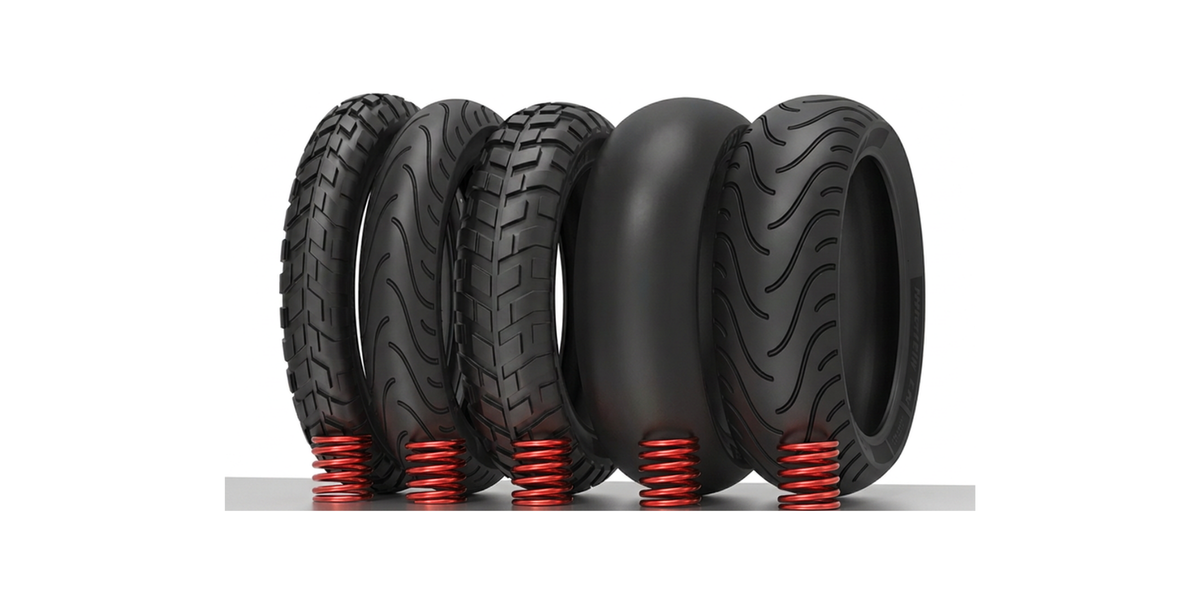
The tire is also a spring. And nobody controls its rebound.
When we talk about suspension, we usually think about the shock absorber, the spring, the fork — everything between the chassis and the ground.
But there is one element that also acts as a spring and that almost nobody mentions: the tire itself.
When it hits a bump or surface irregularity, the compressed air and the rubber carcass deform, storing energy. When the impact ends, that energy is released in the form of mechanical rebound — just like a spring, but without valves, oil, or any internal mechanism to control the speed or amplitude of that return.
The tire returns freely — and that uncontrolled movement has consequences.
What exists inside the tire to manage that rebound
The only internal mechanism that mitigates rebound is the hysteresis of the rubber. Rubber is a viscoelastic material: when it deforms and returns to its original shape, it does not give back 100% of the energy it received. Part of it is lost as heat. High-grip tires are designed precisely with high-hysteresis compounds to absorb the micro-impacts of the asphalt without rebounding immediately.
It helps. But it is not enough to control rebound in real impact situations.
What controls rebound from the outside: pressure
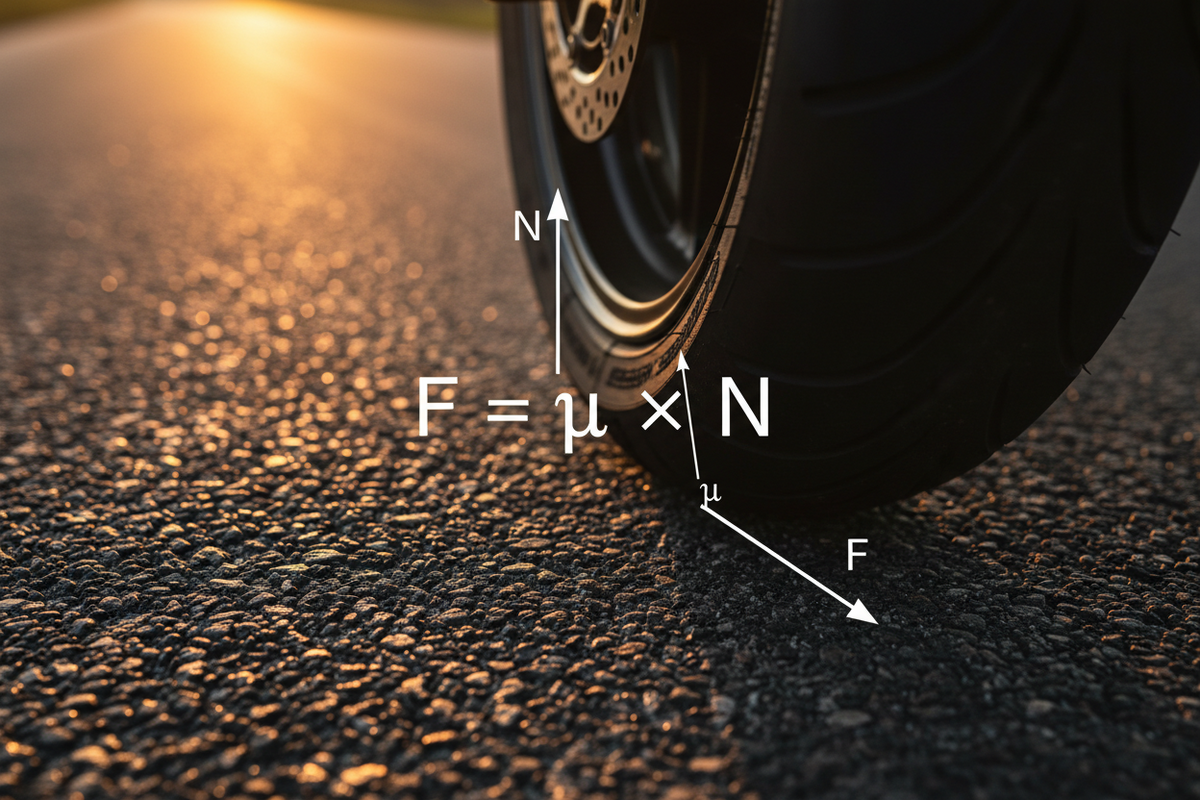
Inflation pressure determines the elastic constant of the tire. In other words, how difficult it is to deform it and how violently it rebounds.
With excessive pressure, the tire becomes rigid. When it encounters any imperfection in the surface, the compressed air expands violently and the tire rebounds without control, generating micro-lifts from the surface that destroy traction.
With optimal pressure, the carcass flexes enough to follow the surface, using the flexibility of the rubber to dissipate part of the rebound naturally before the force is transmitted to the suspension.
Correct pressure is not a detail. It is the first line of defense against uncontrolled rebound.
What neither the tire nor pressure can solve alone
Even with the correct pressure, there remains a limit to what the tire can manage by itself. Conventional suspensions are too slow to react at the speed at which the rubber returns. That return happens in milliseconds. By the time the suspension responds, the rebound has already occurred.
That is why engineering developed complementary solutions that act directly on the unsprung mass, at the exact point where the problem occurs.
In Formula 1, the precedent was Renault’s mass damper: a system installed in the nose of the car to counteract the uncontrolled rebound of the tire sidewalls. It was effective enough to become controversial — and was eventually banned.
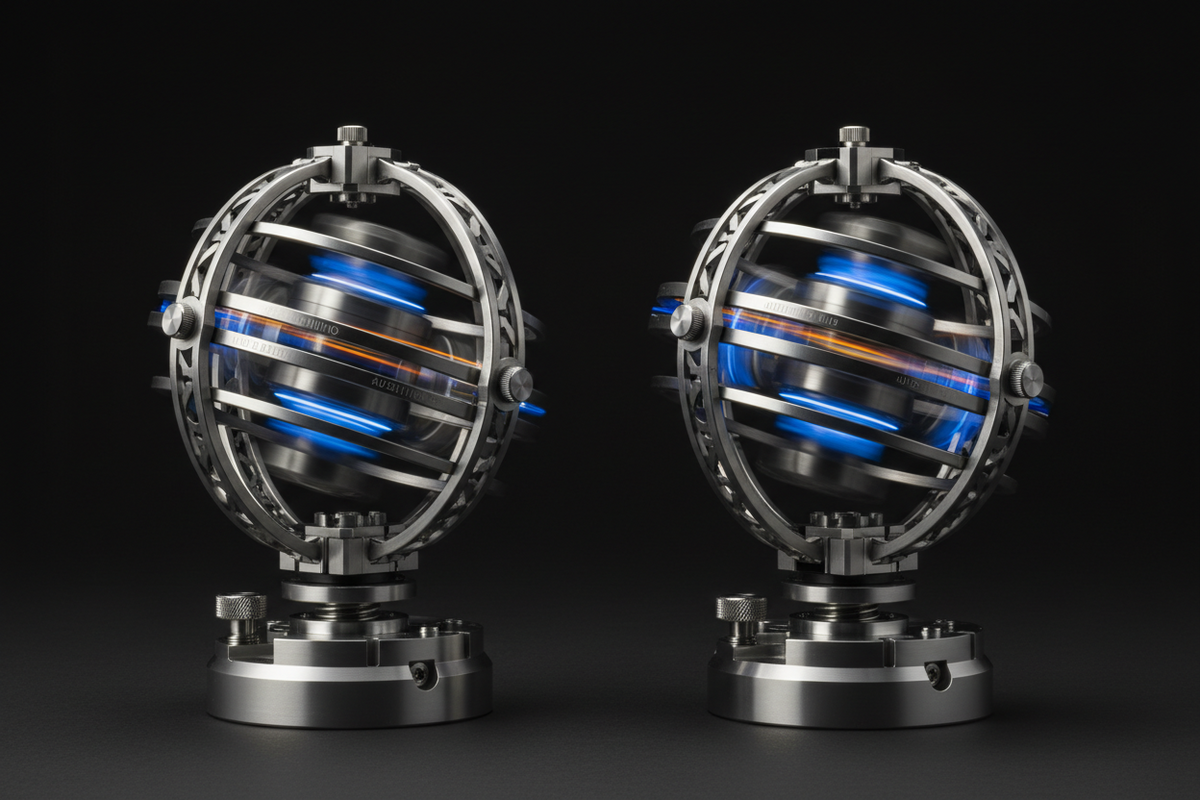
The Oversuspension Gravitational Resonator works on the same principle but with a radically different mechanism. It is installed directly on the swingarm, on the unsprung mass. When the tire hits an irregularity and tends to rebound upwards, the internal mass of the Resonator moves in the opposite direction, generating an active counterforce that immediately cancels the rebound energy.
It does not simply reduce rebound. It does not arrive late like conventional suspension.
It acts at the very moment the rebound occurs, keeping the tire exactly where it needs to be: firmly in contact with the surface.