
Overtaking on a motorcycle
No one thinks of overtaking as a high-risk grip maneuver. You think about visibility, distance, and the oncoming car. Grip is taken for granted.
And yet, few everyday maneuvers demand so much from the rear tire at once.
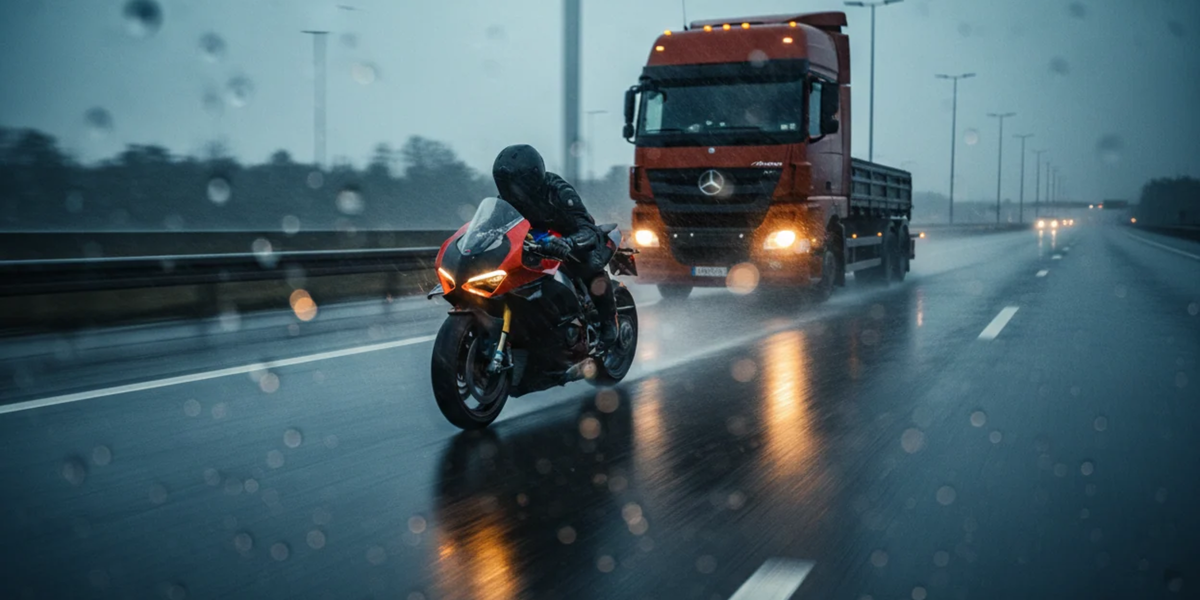
Let's analyze what happens in those three or four seconds. You open the throttle wide, often from a cruising speed with the engine at low rpm: maximum traction demand. You change lanes with the motorcycle still accelerating: lateral load added to the longitudinal. And all of this happens on the worst part of the road surface — the center of the opposite lane and the strip between lanes, where diesel, gravel, and patches accumulate that cars avoid with their four wheels and you cross with one.
Overtaking is the only routine maneuver that combines maximum traction, change of direction, and the worst available asphalt. And you do it several times on each ride.
What rebound does there
On degraded asphalt and with the throttle open, every irregularity causes the rear tire to bounce just when it's transmitting the most torque. Each micro-lift in that phase is traction that disappears: the wheel slips a fraction, the traction control cuts power, the motorcycle accelerates less than expected.
The result is known by any motorcyclist, even if they have never named it: that overtaking where the motorcycle "didn't push" as it should, and the meters of margin with the oncoming car shortened. It wasn't the engine. It was the intermittent traction of a bouncing wheel on broken asphalt during maximum demand.
Traction control exacerbates the perception without solving the cause: each power cut due to slippage lengthens the maneuver. The system does its job — but its job begins when grip has already been lost.
Recovering the meters
The Gravitational Resonator keeps the tire in contact during the phase of maximum demand: the rebound on degraded asphalt is counteracted the instant it is generated, traction becomes continuous, and traction control stops intervening because there is no slippage to manage.
On the track, that's tenths of a second. In an overtake, it's meters. And in an overtake, meters are the margin between you and the oncoming car.