
Hysteresis in the rear tire: the physics of grip that nobody explains to you
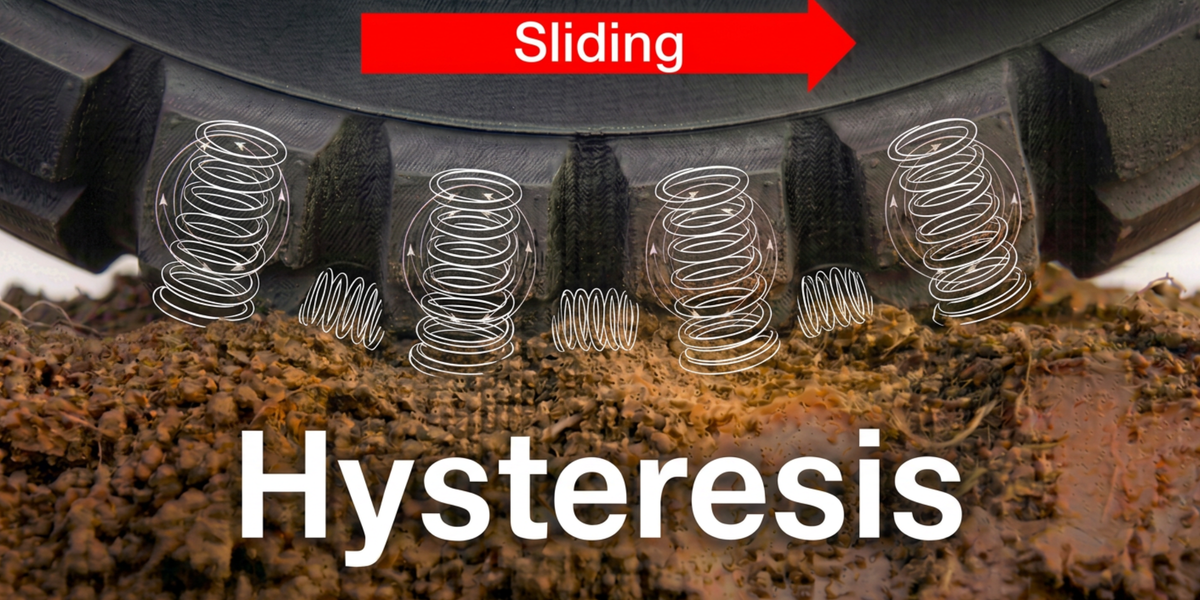
When the rear tire of your motorcycle touches the asphalt, something happens that goes beyond simple friction. The rubber deforms, absorbs energy, and, as it recovers its shape, returns only part of that energy. The rest is lost as heat.
That phenomenon has a name: hysteresis. And in the rear tire of a motorcycle, it plays a crucial role in grip, tire durability, and even the health of your transmission.
High or low hysteresis: the compromise that defines your tire
The rubber compound of the rear tire constantly deforms in contact with the asphalt. What differentiates a racing tire from a touring tire is not the tread pattern or the width. It is how long that rubber takes to recover its original shape.
A high-hysteresis tire absorbs the energy from the road surface and takes longer to return to its original state. This means it adapts perfectly to the micro-roughness of the asphalt, maximizing the real contact between the rubber and the pavement. The result is maximum grip and traction under acceleration. The cost is heat and accelerated wear.
A low-hysteresis tire rebounds faster, dissipates less energy as heat, and lasts longer. But at the limit, that faster rebound can mean less contact with the asphalt, less grip, and a smaller margin before losing the rear tire.
The choice between high and low hysteresis is not technical. It is a decision about how you use the motorcycle and what you prioritize on each ride.
How hysteresis is measured in a tire
In the laboratory, Dynamic Mechanical Analysis is used: the rubber is subjected to oscillating forces to measure how much energy it absorbs and how much it returns.
The relationship between the two is expressed as the loss factor tan(δ), where E'' is the loss modulus —the energy dissipated as heat— and E' is the storage modulus —the energy returned in the rebound.
tan(δ)=E"/ E'
A high tan(δ) value at low temperatures indicates a tire with excellent wet grip. That is why rain tires feel so soft to the touch: they are designed to dissipate energy, not to return it.
Hysteresis in the transmission: the cush drives nobody talks about
Hysteresis does not only work at the contact patch with the asphalt. Inside the rear wheel assembly of most motorcycles, there are rubber blocks placed between the rear sprocket and the wheel rim: the transmission dampers, or cush drives.
Their function is to absorb the violent impact of engine power when you accelerate or release the clutch. Without them, that torque would hit the chain and gearbox gears abruptly. With them, the rubber absorbs that torsional impact and converts it into heat instead of bouncing it back into the transmission.
The hysteresis of these cush drives is measured through a cyclic torsion test: torque is applied, the wheel’s deformation angle is measured, and the hysteresis loop is plotted. The area inside that curve represents exactly the energy that the rear wheel converts into heat instead of transmitting it as mechanical impact.
When those cush drives degrade and lose hysteresis, the transmission starts receiving the shocks they used to absorb. The result is chain snatch, premature gear wear, and a ride that becomes harsh and unpredictable.
Why hysteresis alone is not enough
Rubber hysteresis manages energy at the contact patch. Cush drives manage impact in the transmission. Both work within their ranges and within their response times.
The problem occurs when tire rebound is faster than what any viscoelastic material can manage. In milliseconds, when the tire hits an irregularity at high speed, the hysteresis of the rubber does not have enough time to dissipate all the energy before the rebound has already occurred.
This is where hysteresis may no longer respond quickly enough. The Oversuspension Gravitational Resonator is designed to act at the instant rebound is generated, pushing the tire toward the asphalt before lift-off occurs.
Hysteresis manages energy within the tire. The Gravitational Resonator addresses what hysteresis cannot: the moment the tire begins to lift from the ground.