
The difference between fear and respect on a motorcycle
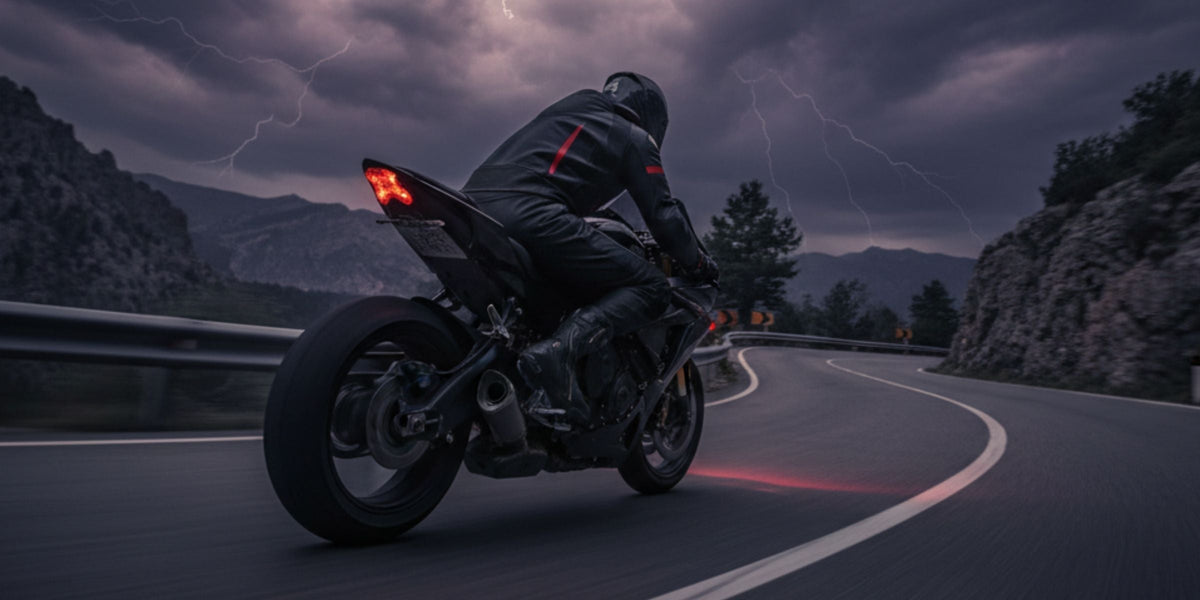
There are two motorcyclists taking the same wet curve. They are going at the same speed, on the same bike, in the same rain.
One is stiff. His arms are rigid on the handlebars, his gaze fixed three meters in front of the wheel, his body expecting disaster. Every joint in the asphalt pierces his chest.
The other is attentive. His arms are loose, his gaze is on the exit of the curve, his body accompanying the bike. He knows exactly what is happening beneath him and how much margin he has left.
The first one is afraid. The second one has respect. And the difference between them is not courage. It's knowledge.
Fear is not knowing
Fear on a motorcycle almost always comes from the same place: from what you don't understand. The vibration you don't know where it comes from. The swerve you didn't expect. The feeling that the bike is doing things on its own.
When you don't know what's happening beneath you, your brain fills the void with the worst available hypothesis. It's its job: it has kept you alive this way for thousands of years. But on a motorcycle, this ancestral response works against you. Fear stiffens your arms, narrows your vision, hardens your inputs. And a bike ridden rigidly responds worse, which generates more strange sensations, which fuels more fear.
It's a self-perpetuating cycle. And it's not broken by bravery. It's broken by understanding.
Respect is knowing
The motorcyclist who understands his machine doesn't fear it. He respects it, which is something completely different.
He knows that the tire bounces thousands of times per kilometer and he knows why. He knows that cold rubber grips less for the first few minutes and adjusts his pace accordingly. He knows that on a wet curve the lateral margin is narrow and chooses his speed with that data, not against it. He knows that his suspension works on one time scale and the tire rebound on another.
Respect doesn't diminish enjoyment. It enhances it. Because those who understand the limits can move within them with ease, while those who ignore them cross them unknowingly or stay so far from them that they never flow.
Fear tells you "don't go." Respect tells you "go like this." One narrows your world. The other orders it.
A necessary clarification: fear is not the enemy
Acute fear—the kind that arises from a real and immediate danger—is a functioning alarm system that no motorcyclist should want to disable. If something genuinely scares you, the correct response is usually to stop, not to persist.
What we are talking about here is chronic fear: the kind that accompanies every ride without specific danger, the kind that comes from not understanding the machine and turns every kilometer into tension. That doesn't protect. It wears you down. And it has a solution, because its cause is not danger but ignorance of what is happening beneath you.
This entire blog exists, ultimately, for that. The physics of rebound, frequencies, hysteresis, unsprung mass. These are not articles for engineers. They are tools to convert inexplicable sensations into understandable phenomena. What you understand stops scaring you and starts to be respected.
The margins you choose
Respect translates into concrete decisions. The motorcyclist who respects the road chooses their margins instead of leaving them to chance: the equipment they wear, the pressure they check, the pace they adapt to cold tires or wet asphalt.
And they also choose what to do with what they cannot control. Tire rebound occurs on a time scale where neither the most expert hand nor the most advanced electronics can reach. There, no riding technique is valid: either contact with the asphalt is guaranteed by the system, or it is left to the luck of each irregularity.
The Gravitational Resonator is that: not a substitute for respect, but one of its expressions. The margin you choose to close in the only range where you cannot act.
Fear hopes nothing happens. Respect ensures that, if something does happen, the wheel stays where it should be: glued to the ground.