
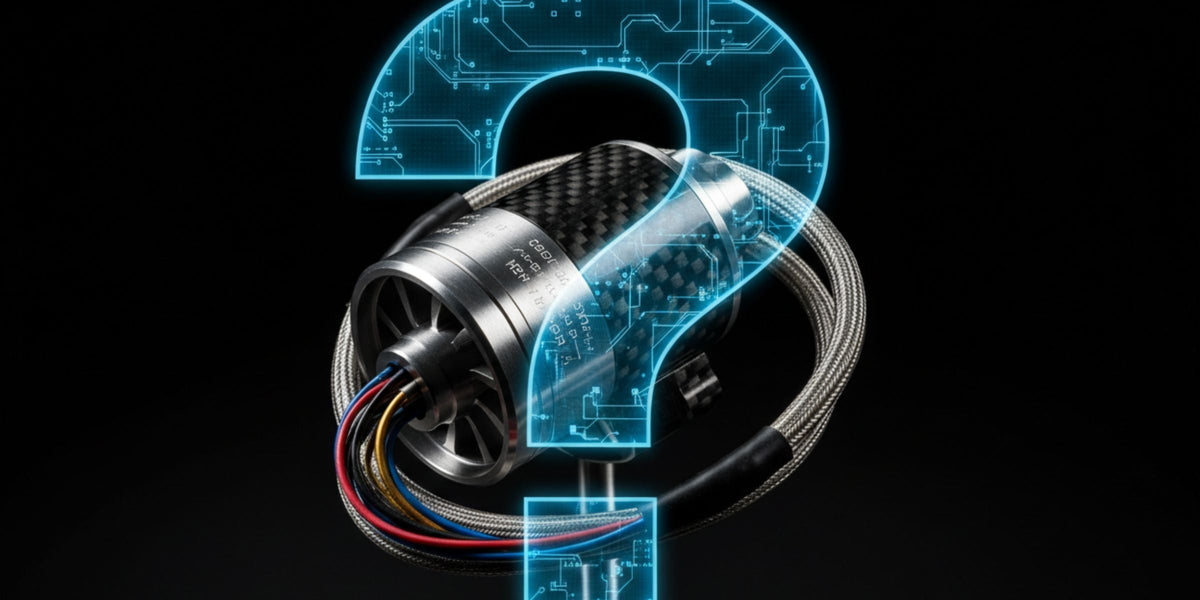
Where does the sensor go on the Oversuspension?
Almost everyone's first reaction when learning about the Gravitational Resonator is to look for the chip. Where does the sensor go? What ECU controls it? How often does it sample?
There is no chip. There is no sensor. There is no ECU. And it's not a deficiency: it's the design decision that makes everything else possible.
The electronic chain problem
Any electronic control system follows the same sequence: a sensor measures, an ECU processes, an actuator responds. Each link consumes time. In the best systems on the market, this complete chain executes in milliseconds - an extraordinary speed, sufficient for ABS, for traction control, for everything that manages the consequences of a loss of grip.
But tire bounce doesn't wait for the chain to finish. It occurs on the same timescale as the sensor would be measuring. An electronic system that wanted to counteract it would always be one link too late: it would detect the bounce when the tire is already in the air.
The mechanical response has no chain
The Resonator does not measure the bounce: it receives it. It is mounted on the unsprung mass, exposed to the same forces as the tire, with no filter between it and the phenomenon. When the swingarm is excited, the mass of the Resonator is already moving - not because a processor commands it, but because physics dictates it. The response and the stimulus are the same event.
This suddenly eliminates everything that makes electronic systems vulnerable: no battery to drain, no sensor to recalibrate, no software to update, no connector to corrode, no fault mode. A mechanical system made of tungsten, aerospace steel, and polyurethane has no error states. It works the same on day one as it will twenty years from now, in dry conditions, in rain, at -5 ºC or at 40 ºC.
This is why Oversuspension can offer a lifetime warranty: it doesn't promise on electronics.
Intelligence is in the material
No chip doesn't mean no adaptation. The polyurethane buffer with metallic fillers responds with more rigidity the more violent the impact - the system modulates its response according to the intensity of the problem, without processing a single data. And the adjustment ring puts in the rider's hands the only parameter that an algorithm cannot know better than you: what terrain you are going to ride on today.
Electronics manage the consequences milliseconds later. Mechanics act instantly. For tire bounce, that difference is everything.