
Why your suspension isn't managing your wheel's rebound
During motorcycle use, your bike’s suspension is subjected to a continuous and variable workload.
Road surface irregularities, changes of direction, and mass transfers under braking and acceleration all place continuous demands on the system.
The widespread assumption is that the suspension absorbs and manages all of these forces. The reality is more complex.
The tire is not a passive element of the system.
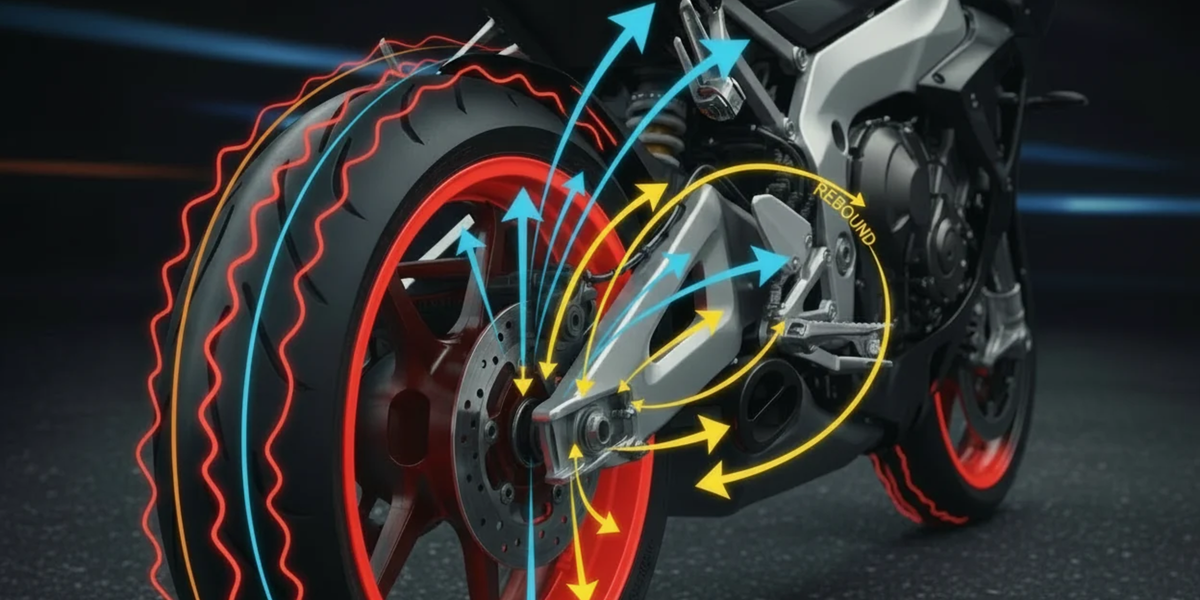
It has mass and its own elasticity, and it generates forces that act independently of the suspension. When the tire’s elastic rebound is out of phase with the suspension’s movement, the two systems begin to work against each other. The result is a set of unwanted forces that vary in frequency and amplitude, are transmitted directly to the suspension, and disrupt its normal compression and extension cycle.
Conventional suspension calibration is essentially static. Springs, damping, and geometry are set for a defined range of conditions. Yet the forces acting on the suspension during riding are constantly changing, varying in frequency, amplitude, and intensity over time. The system’s response remains fixed, while the problem it must manage is continuously evolving.
This mismatch between the static stiffness of the setup and the dynamic variability of the forces creates an operating zone outside the optimal calibration range.
This creates a zone where the suspension no longer performs at the level it was designed for, and where the tire progressively loses its ability to maintain consistent contact with the asphalt.
The problem is not the suspension.
Rather, the limitation is that no conventional suspension can solve a dynamic problem with a static solution.
This is where the device intervenes: it monitors, in real time, the vibrations generated by the tire’s elastic rebound.
When it detects a phase shift relative to the suspension’s trajectory, it actively intervenes by generating a counter-phase response. This creates a force of equal amplitude and frequency, but in the opposite direction, cancelling the abnormal forces before they are transmitted to the suspension system.
The result is continuous synchronization between the tire cycle and the suspension cycle.
Unlike conventional static calibration, the Oversuspension device operates in real time and adapts its response to every variation in the forces.
It responds differently to each situation: high frequency on damaged pavement, progressive response during changes of direction, and immediate action against isolated impacts. The system does not have a fixed setting because the problem it solves is not fixed.
The practical consequences are direct and measurable:
The tire maintains consistent contact with the asphalt by eliminating the forces that cause momentary lift-off. The suspension works within its optimal calibration range by no longer receiving the abnormal inputs that push it out of its design cycle.
The motorcycle-rider system gains stability in the situations where conventional systems begin to fall short: irregular asphalt at high pace, demanding braking zones, corners with variations in grip.
Oversuspension does not improve the suspension. It solves what no suspension, by itself, can solve.